
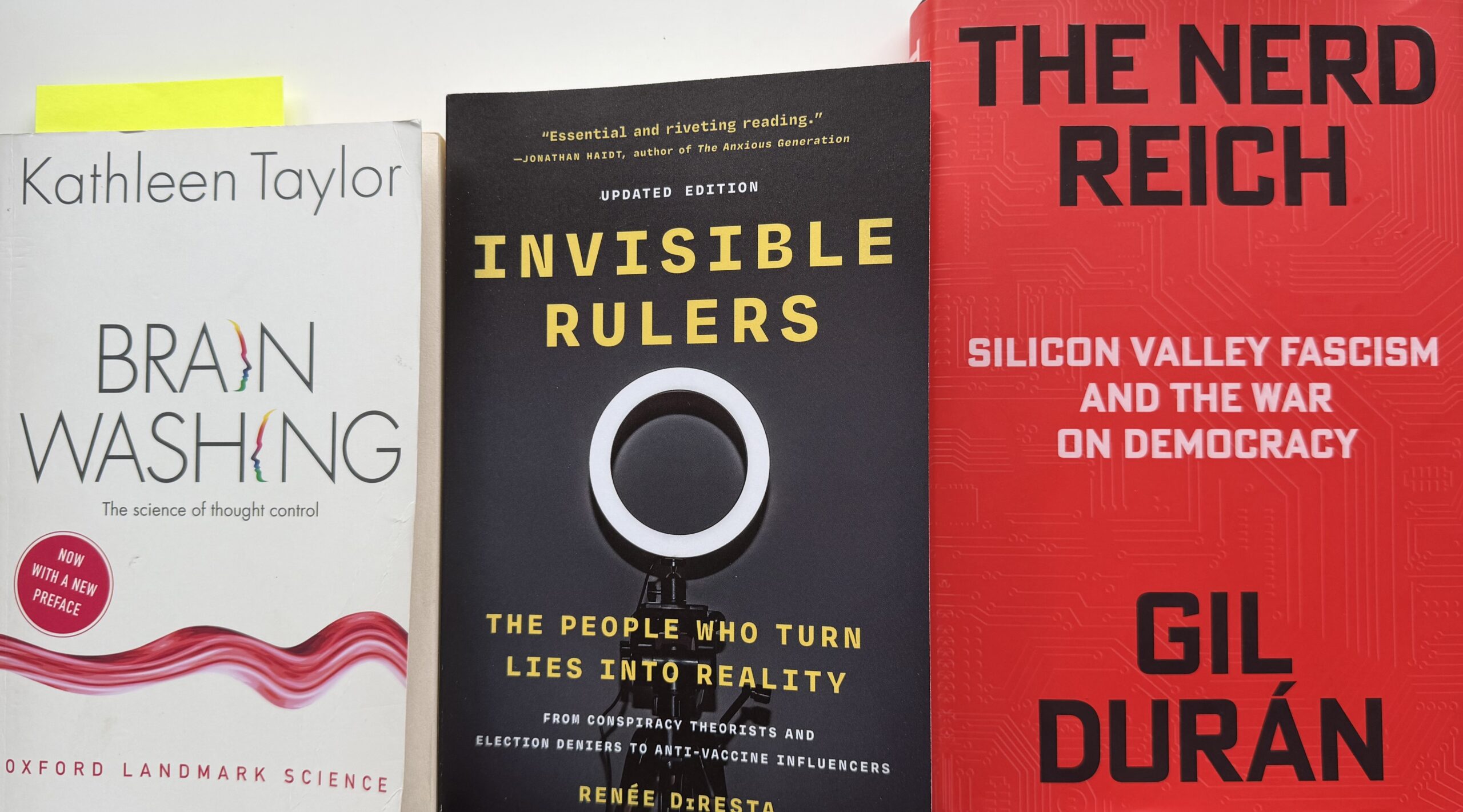
Over the last few months I’ve read three fascinating nonfiction books that are worth reviewing together. They cover similar themes, even though they were written and published in different countries and several years apart. The disciplines they cover are wide, but related.
All of them are highly and disturbingly relevant to today’s world.
First is Kathleen Taylor’s Brain Washing: The Science of Thought Control, part of the Oxford Landmark Science series published by Oxford University Press in 2004. I read the 2017 edition, which is mostly unchanged from 2004 except for a new preface that sends alarm bells ringing. Taylor wrote in the first page of that new preface, “much of what I wrote in 2004 – like the warnings about ethereal ideas, strong emotions, identity politics, and new technologies – has become more relevant, not less” (page ix).
She wrote that new preface towards the end of 2016, the year the UK voted very narrowly in an advisory referendum to leave the European Union. That was taken as a definitive mandate and, well, here we are ten years later in a much worse situation than then.
Taylor is an expert in cognitive neuroscience and the book dives into some fascinating explanations about how our brains work. She set herself the task to outline what is meant by “brainwashing” and trotted through an extensive history of both the term and what it’s meant. The meat of the book is about intentions and possibilities, both at an individual level and more broadly.
In my 2023 talk about disinformation, which I’ve included here on my blog, I referred a few times to needing to take a break from constant and urgent calls to share questionable information on social media. I likened it to the practices seen often in fraud. Taylor exhorts us to stop and think.
The bad news is that there are way too many people thinking that “brainwashing”, or thought control, is achievable. The good news is that it’s more complicated than that.
Taylor ends with a proposed approach to counteract those who seek to control others’ thoughts. I won’t go into it now, suffice it to put the mnemonic here for a strategy to defend against what she called the “terrors of brainwashing” (page 393): FACET – Freedom, Agency, Complexity, Ends-not-means, and Thinking.
I recommend this book to lay people who are interested in the science behind this authoritarian craving by a few.
Second is Renée DiResta’s Invisible Rulers: The People Who Turn Lies Into Reality. The edition I read was the 2026 update from the original 2024 book published by Public Affairs Books.
DiResta is a survivor of the anti-vaccine movement in the USA, and begins the book with a personal recounting of how she was targeted when trying to keep kids safe from a measles outbreak. That was in 2014. Since then, she’s developed an expertise in the tactics used by conspiracy theorists, social media influencers, and that bunch of very rich people who are seeking to undermine democracy around the world.
The book covers much of the Covid-19 stuff, the 6 January 2020 insurrection in the USA, and many of the ideological battles that took place a hundred years after fascism was first articulated.
DiResta knows her stuff, and writes about complex issues articulately. It is an excellent book on explaining some really wild stuff, and skewering nonsensical arguments repeated by people who really, really ought to know better. Take the use of “free speech” as a rallying cry for a helluva lot of bigots:
“The big fight over ‘free speech’ is about preferred dissemination. It is a fight about algorithmic amplification, share of voice, and the ability to reach vast audiences at no cost – recast as if they were rights. It’s a fight for power, for dominance of communication infrastructure and the capacity to shape public opinion” (page 298).
You can see why I linked DiResta’s work to that of Taylor’s.
Like Taylor, DiResta includes a chapter about how to counteract these attempts to shape public opinion. She reminds us that many of the techniques used have been used before, and we know how to deal with them. It’s not easy, but it is necessary if we want to survive. DiResta frames it as an exercise in deploying many old anti-propaganda techniques rather than seeking a tech solution. But, even these aren’t a panacea, she warns.
Because of her own lived experience, DiResta focussed on a series of attacks against academics at various institutions in the USA. She strongly points out that communication strategies are just as important as any legal one, and also for institutions to understand the true nature of the attacks. It is not good faith debate.
A little like Taylor with her updated preface, DiResta’s additional epilogue in this edition published barely two years after first publication includes an acknowledgment by the author about how far and fast the people trying to shape public opinion were moving. She begins by referring to measles outbreaks in California during 2015 and in West Texas in 2025. Present Health Secretary in the USA, Robert F. Kennedy Jr., was involved in the anti-vaccine movement back in 2015, he’s now in charge of public health for the entire country and in a regime that is destroying government agencies at speed.
DiResta points out that “the apex of power understand exactly how the system works – and are willing to start rumours and manipulate media themselves” (page 366). “In today’s information environment, not speaking when you are attacked … doesn’t protect you – it just ensures that lies become the most accessible version of events” (page 380); “bad-faith actors playing power games won’t leave you alone or treat you fairly. Appeasement doesn’t preclude escalation” (page 381). There are a lot of people who need to understand these points.
She ends the new epilogue with these two ideas: “The challenge isn’t ideological – it’s structural” (page 383) and “Showing up, speaking out, organising, correcting the record, building networks of trust and truth – these are how something better takes root” (page 385).
I highly recommend this book, too, for people seeking to understand how propaganda works now and a bit of insight into how to fight against it.
Third and final book I finished reading today. It’s Gil Durán’s The Nerd Reich: Silicon Valley Fascism and the War on Democracy published in 2026 by Simon&Schuster. In a sense, Durán makes visible the “invisible rulers” of DiResta’s book.
The book’s first chapter opens with this statement: “To understand the right-wing radicalization of Silicon Valley politics, you must understand Peter Thiel. To understand Thiel, you must understand the formative role the book The Sovereign Individual: How to Survive and Thrive During the Collapse of the Welfare State and its authors James Dale Davidson and William Rees-Mogg played in shaping his political outlook” (page 13). I haven’t read this book, but I recall ten years ago learning about it when I was seeking to understand Jacob Rees-Mogg’s bleating about Brexit restoring sovereignty to the UK. The UK parliament hadn’t lost any of its sovereignty while the UK was a member of the EU. It turned out that Jacob was blathering on about his dad’s ideas. My little research foray back then ended up inspiring some of the plot points in my novel, The Disinformation War.
The rest of this book is an excellent summary of the men (and a couple of women) who together have started wrecking the USA as a standard bearer for liberal democracy. Many of the names are familiar to anyone paying any kind of attention to movers-and-shakers in Silicon Valley and Wall Street over the last few decades. Durán brings it all neatly together, and it’s horrifying. Especially when put together with DiResta’s book and Taylor’s. Durán points out that “democracy’s enemies specialise in long-term strategies, and they have enough money to operate in perpetuity; they are scheming for global control” (page 255).
He also describes the tech revolutions that were supposed to bring about Thiel’s vision, and now kind of are: blockchain, cryptocurrencies, non-fungible tokens, and now artificial general intelligence (or whatever it’s being called now)… ventures in all of these were funded by Thiel and his chums and a lot of men got very, very rich and powerful. (To note, the technological developments in and of themselves are not necessarily evil or dead ends of research.)
However, Durán makes this key point: “we also have the power to imagine and to dream of realities not yet possible. We must shatter the billionaire monopoly on the future If the billionaires can imagine hoarding wealth, toppling nations, cheating death, and living on Mars, we can imagine a world without them – and we must build it” (page 257). In that, he is like DiResta and Taylor in including a viable way forward, albeit without a magic bullet or quick solution. Taken together, and read over three years after The Disinformation War was published, I am surprised by how close I called quite a few strategies and tactics used by the antagonists in my novel. As an author, that’s a weird feeling.
I recommend Durán’s book as another easy read about a complex topic. As all three writers point out in their own ways, knowing our enemies is vital before we can work out the best ways to counteract their murderous intentions… because their intentions are murderous. Both DiResta and Durán point out that people have already died, and more will, unless this round of fascists are defeated.
The penultimate line of the book is a rallying cry: “revolutions start in the imagination, and that’s one thing the fascists can’t take away from us” (page 263).
Leave a Reply