
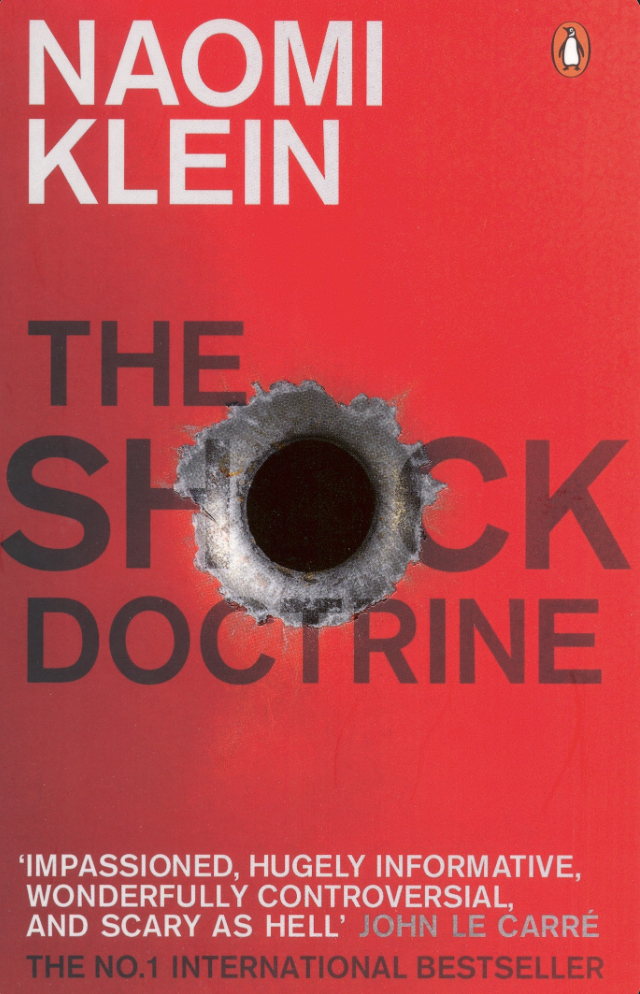
I’ve had this book by Naomi Klein on my list of books to read for a while, but hadn’t got around to reading it until recently. It fit particularly well with my non-fiction reading list for this year, and became a bit more urgent given the way the world is at present. It’s worrying just how many books like this were written as warnings that seem to have been all but ignored.
To note the adage, if your Naomi is Klein, you’re fine… This author is the Naomi who hasn’t gone full-bore conspiracy-theory adherent.
Briefly, Canadian journalist Naomi Klein was writing stories about headline-grabbing disasters and came to the realisation that more was going on than one group of people taking advantage of terrible situations to make money. The term to describe it is “disaster capitalism”.
In the introduction, Klein described her experience in the aftermath of Hurricane Katrina on New Orleans in the USA. She quotes an exchange which sums up a key point:
…an older man in line in front of us … whipped around. ‘What is wrong with these people in Baton Rouge? This isn’t an opportunity. It’s a goddamned tragedy. Are they blind?’
A mother with two kids chimed in. ‘No, they’re not blind, they’re evil. They see just fine.’ (page 4)
Klein’s main focus is Milton Friedman of the Chicago School and those who followed his teachings. The book spells out where Friedman and his acolytes applied Friedman’s theories, and explores the idea that they sought out socio-economic “shocks” in order to implement significant changes that would have been resisted through the electoral ballot box.
The book was first published nearly 20 years ago, in 2007. In many ways it was a different world then. I’ve just started reading Klein and Astra Taylor’s new book, End Times Fascism, which picks up some of the threads in Klein’s earlier book. It’s not surprising. There are many concepts and ideas that clearly link up to what we’ve been experiencing in more recent times.
Klein’s thesis goes some way to explain the inadequate action to tackle climate change. Put simply, it fits the type of “shock” that plays into the hands of the super-rich to get more rich.
It’s not all doom and gloom. By coincidence, I was reading the last chapter of The Shock Doctrine as the first meaningful results of the 2026 mid-term elections in the USA were coming through. Twenty years ago, the 2006 mid-term elections in the USA saw the Democratic Party soundly defeat the Republicans. Klein attributed the results then to political corruption that led to key players either in prison or facing serious charges, the mismanagement of the war in Iraq, and the true effects of the Chicago School’s economic policies of privatisation, deregulation, and cutting government services.
Sound familiar?
To loop back to what’s captured in the quote above made by ordinary people in New Orleans, Klein cited Chilean Orlando Letelier writing in 1976:
For Letelier, it was obvious that the [Chilean] dictatorship’s ‘free market’ rules were doing exactly what they were designed to do: they were not creating a perfectly harmonious economy but turning the already wealthy into the superrich and the organised working class into the disposable poor. These patterns of stratification have been repeated everywhere that the Chicago School ideology has triumphed. (page 444)
Klein also cites Rodolfo Walsh, who was murdered in Buenos Aires, as pointing out that “the Chicago School ascendancy in Argentina [was] a setback, not a lasting defeat. … shock, by its very nature, is a temporary state” (page 446). Klein goes on to point out that human beings need stories through which we function and grow as people. Those who have signed up to the Chicago School ideology and tenets of disaster capitalism want “clean slates” on which to build their vision, but total regression, or a psychological blank slate, is not the only reaction to severe shock that humans exhibit. Many of us react as the social creatures we are in the face of overwhelming disaster. That’s a vitally important thing to remember. Klein’s concluding paragraph reminds us of alternatives to what the Chicago School ideologues would have us believe is inevitable.
There are some tough passages to read in The Shock Doctrine, but they’re necessary to record realities. What I think Klein does best is bring together the brutal politics and grotesque human rights abuses with the clinical economics. They are too often discussed as though they are completely separate things.
If you’re interested in how we got to where we are, and want some clues as to how to change our collective path, this book is a good one to read. It stands up fairly well to the test of time, too, and for all the details contained, is a cracking read.
Leave a Reply